
How many sets a muscle needs per week
The number that decides whether you grow. Not four, not forty.
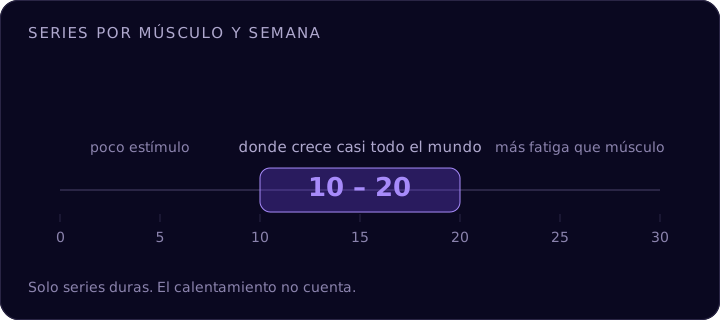
The useful range
For muscle growth, most people respond well to 10-20 hard sets per muscle group per week — hard meaning one or two reps short of failure. Below 10 you can still grow, especially as a beginner, but you are leaving results on the table. Above 20 almost nobody recovers well, and what shows up is not extra muscle: it is tired joints and a growing urge to skip the gym.
What counts and what doesn't
A set counts when it gets close to failure on an exercise that actually loads that muscle. Warm-ups do not count. Ramp-up sets do not count. And muscles working as helpers count partially: your triceps do their share on a bench press, but that is not the same as a set of extensions. If you do 12 sets of chest and 8 of triceps, your triceps got well over 8.

Start at the bottom
The classic mistake is entering through the ceiling. Start at 10-12 sets per muscle, hold it for four or five weeks and watch two things: whether the weights go up, and whether you show up to the next session wanting to train. If both are yes and you want more, add two or three sets the following week. Adding volume is easy; recovering from too much is not.
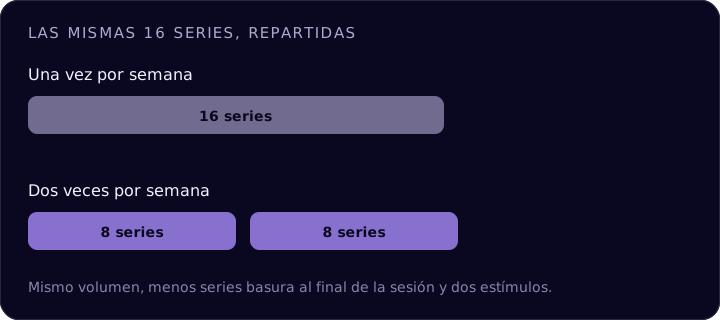
The short version
Volume is a dose, not a virtue. More is not better: better is the most you can recover from and repeat week after week.
More on Hypertrophy
Close to failure, not always to failure
What RIR is, why you leave one or two reps in the tank, and when to push.
Progress without stalling: double progression
When to add weight, when to add reps, and why not both at once.
How long to rest between sets
Two minutes is not a quirk: it is the reps on your next set.
Once a week per muscle is not enough
Why splitting your volume over two or three days beats one hammering.
Protein: how much and how to spread it
The daily total is what matters. The exact timing, far less than you hear.
Stalled: what to check before switching routines
It is almost never the routine. Five things to check first.
This is general information written from the training literature, not medical advice or a personalised plan. If you take medication, have a health condition or something genuinely hurts, the person to ask is a healthcare professional.